
Pesto Chicken Salad: The Vibrant, Herb-Packed Recipe That Elevates Everyday Chicken Salad
Pesto Chicken Salad takes the familiar comfort of classic chicken salad and transforms it completely with one inspired addition — basil pesto. Where a traditional chicken salad relies on mayonnaise for its character, the pesto version replaces or supplements that creamy base with an intensely aromatic, herbaceous sauce that turns every bite into something genuinely exciting. The result is a chicken salad that is brighter, bolder, more vibrant in color, and far more interesting in flavor than anything a plain mayonnaise dressing can produce.
Pesto — the classic Genovese sauce of fresh basil, garlic, pine nuts, Parmesan, and good olive oil — brings an entire personality to the dish rather than merely providing a creamy binder. Its fragrant basil depth, the sharpness of garlic, the nuttiness of pine nuts, the salty intensity of Parmesan, and the fruitiness of olive oil combine in a way that makes chicken salad feel like a genuinely composed Italian-inspired dish rather than a simple lunch staple.
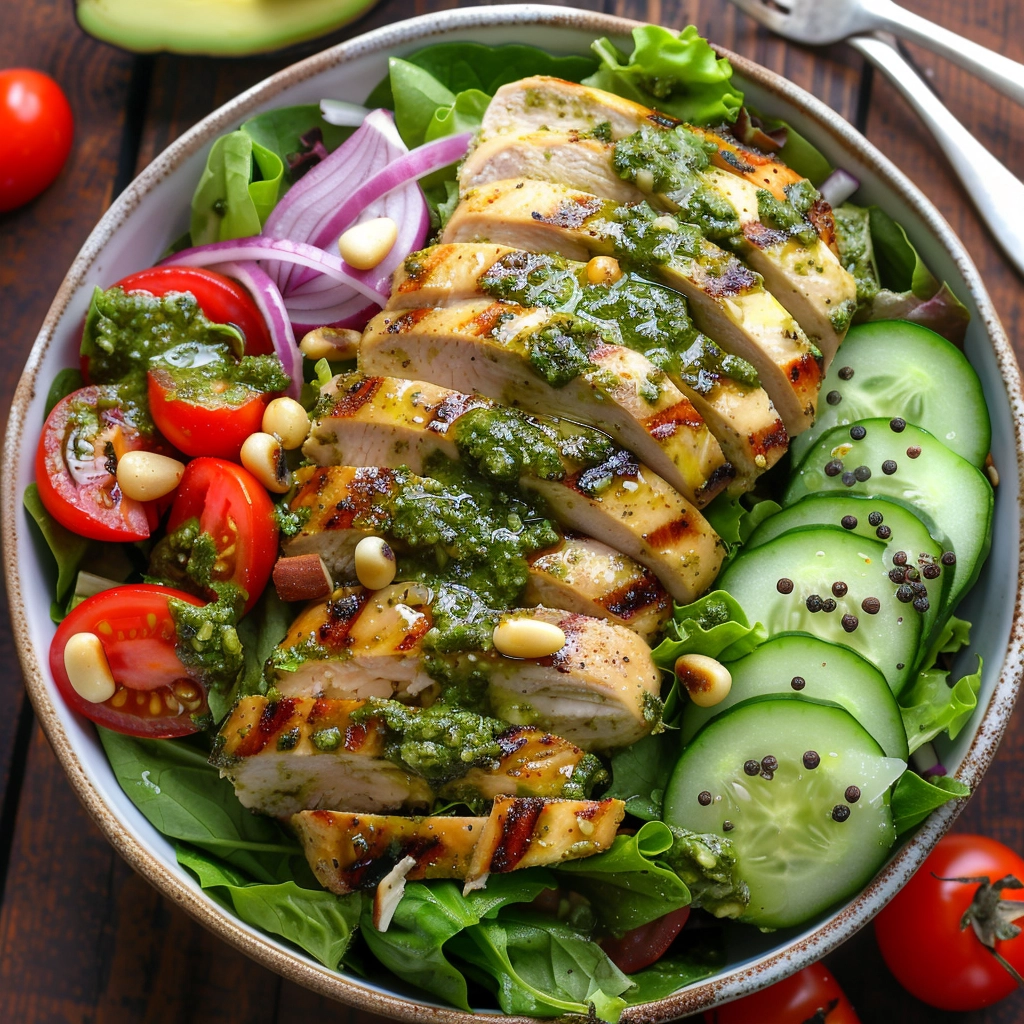
This salad works for virtually every occasion — sandwiches, lettuce wraps, stuffed tomatoes, grain bowls, pasta salad bases, or simply eaten from the bowl with a fork. It comes together in under twenty minutes, holds beautifully in the refrigerator for days, and impresses consistently without demanding any technique more complex than shredding cooked chicken and mixing it with a great sauce. It is the kind of recipe that makes regular chicken salad feel permanently inadequate by comparison.
What Makes Pesto Chicken Salad Special
The magic of pesto chicken salad lies in the way pesto functions simultaneously as dressing, seasoning, and flavoring — three roles that normally require three separate components in a standard chicken salad. The olive oil in the pesto lubricates and coats the chicken. The garlic and Parmesan season it. The basil and pine nuts define its flavor character entirely.
The result is a chicken salad where every ingredient serves the overall vision rather than simply filling space. The chicken absorbs the pesto deeply, particularly when still warm. The supporting vegetables and additions are chosen to complement rather than compete with the herbal intensity of the pesto. And the final dish tastes coherent and deliberate in a way that distinguishes thoughtfully constructed food from food that is merely assembled.
The color alone sets this salad apart. The vivid green of the pesto coating the pale chicken, punctuated by the red of sun-dried tomatoes or cherry tomatoes and the white of fresh mozzarella, makes the dish as visually striking as it is delicious. It looks like a salad that required effort. It does not require effort. That gap between appearance and reality is one of the most satisfying qualities any recipe can have.
Key Ingredients
The Chicken
Shredded chicken is the ideal form for pesto chicken salad. It absorbs the pesto more thoroughly than diced chicken and creates a cohesive, creamy salad rather than distinct chicken chunks surrounded by dressing.
Poached chicken breasts simmered gently in salted water or broth produce the most tender, moist result. The key is a gentle simmer rather than a boil — aggressive heat toughens the protein. Season the poaching liquid with a bay leaf, garlic, salt, and a few peppercorns for chicken that is flavorful before the pesto even touches it.
Rotisserie chicken is the fastest and most practical option — already cooked, already seasoned, and ready to shred in minutes. Pull meat from both the breast and thigh for a mixture that balances the lean texture of the breast with the juicy richness of the thigh.
Grilled chicken adds a subtle smokiness that pairs particularly well with the herbaceous intensity of the pesto. Grill with simple seasoning — olive oil, salt, pepper, garlic — and allow to cool slightly before shredding.
Whichever method is used, toss the chicken with the pesto while it is still warm whenever possible. Warm chicken absorbs the pesto more thoroughly, producing a salad that is flavored throughout rather than merely coated on the surface.
The Pesto
The pesto is the defining ingredient and its quality determines the quality of the entire salad. There are two approaches — homemade and store-bought — each with legitimate advantages.
Homemade Basil Pesto:
- 2 cups fresh basil leaves, packed
- ⅓ cup pine nuts, lightly toasted
- 2 garlic cloves
- ½ cup freshly grated Parmesan cheese
- ½ cup extra virgin olive oil
- Salt and black pepper to taste
- 1 tablespoon fresh lemon juice
Blend the basil, pine nuts, garlic, and Parmesan in a food processor until finely chopped. With the processor running, slowly stream in the olive oil until the sauce is smooth and creamy. Season with salt, pepper, and lemon juice. The lemon juice helps preserve the bright green color and adds a brightness that elevates the overall flavor.
Homemade pesto is noticeably superior to store-bought — fresher, more aromatic, and more vibrant in both color and flavor. It takes five minutes to prepare and keeps in the refrigerator for up to a week with a thin layer of olive oil pressed on the surface to prevent oxidation.
Store-bought pesto is a perfectly acceptable shortcut when time is limited. Choose a refrigerated variety rather than shelf-stable jarred pesto — the flavor is significantly fresher and more herbaceous. Taste it before using and add a squeeze of fresh lemon juice and a tablespoon of freshly grated Parmesan to boost its brightness and depth.
The Creaminess Component
Pure pesto chicken salad — pesto alone mixed with chicken — is excellent but can feel slightly oily and lacks the creamy cohesion of a traditional chicken salad. Adding a small amount of a creamy ingredient addresses this without diluting the pesto flavor.
Greek yogurt is the most balanced option — it adds creaminess and a pleasant tanginess with minimal caloric impact and the additional benefit of protein. Two to three tablespoons per cup of shredded chicken is the right proportion.
Mayonnaise provides a more traditional creamy texture with a neutral flavor that allows the pesto to dominate. A one-to-one ratio of pesto to mayonnaise creates a dressing that is creamy, richly flavored, and deeply satisfying.
Cream cheese — softened — produces the richest, most indulgent result with a thick, spreadable consistency that works particularly well for sandwich fillings and stuffed vegetables.
Supporting Ingredients
Fresh mozzarella — cubed or in small ciliegine balls — adds a mild, creamy dairy element that complements the pesto’s Italian character beautifully. Its soft texture contrasts with the shredded chicken and any crunchy additions.
Sun-dried tomatoes — roughly chopped — provide an intensely sweet, slightly tangy, chewy element with a concentrated tomato flavor that contrasts brilliantly with the herbal pesto. Their deep red color makes the salad visually striking.
Cherry tomatoes — halved — add fresh, juicy acidity. Use them alongside or instead of sun-dried tomatoes for a lighter, more refreshing character.
Toasted pine nuts — scattered over the top — echo the pine nuts in the pesto and add a satisfying, buttery crunch that provides textural contrast to the creamy shredded chicken.
Fresh basil leaves — added last — reinforce the pesto’s herbaceous character and add visual freshness.
Baby arugula or spinach — folded through — adds a peppery or mild leafy element that lightens the salad and makes it more suitable as a standalone bowl.
Artichoke hearts — drained and quartered — contribute a tender, slightly tangy, distinctly Italian element that elevates the salad considerably.
Step-by-Step Recipe
Prep Time: 15 minutes Cook Time: 18 minutes (if poaching chicken) Total Time: 35 minutes Servings: 4
Ingredients
- 3 cups cooked, shredded chicken (2 large breasts or 1 rotisserie chicken)
- ⅓ cup basil pesto (homemade or good quality store-bought)
- 3 tablespoons Greek yogurt or mayonnaise
- ½ cup fresh mozzarella, cubed or ciliegine
- ½ cup sun-dried tomatoes, roughly chopped
- ¼ cup toasted pine nuts
- ½ cup cherry tomatoes, halved
- 2 tablespoons fresh basil leaves, torn
- 1 tablespoon fresh lemon juice
- Salt and black pepper to taste
Optional additions:
- 1 cup baby arugula or spinach
- ½ cup artichoke hearts, quartered
- 2 tablespoons freshly grated Parmesan
Instructions
Step 1 — Cook and shred the chicken. If poaching from scratch, place chicken breasts in a saucepan and cover with cold water. Add a pinch of salt, one garlic clove, and a bay leaf. Bring to a very gentle simmer — not a rolling boil — over medium heat. Cook for 16 to 18 minutes until the internal temperature reaches 165°F (74°C). Remove from the liquid and allow to rest for five minutes before shredding into generous, irregular pieces with two forks. If using rotisserie chicken, pull and shred the meat directly from the bird.
Step 2 — Make the pesto dressing. In a large mixing bowl, combine the pesto, Greek yogurt or mayonnaise, and fresh lemon juice. Whisk together until smooth and uniformly combined. Taste — the dressing should be intensely herbal, creamy, and well-seasoned. Add a pinch of salt and pepper if needed.
Step 3 — Toss the chicken. Add the shredded chicken to the pesto dressing while it is still warm if possible. Toss thoroughly until every piece of chicken is evenly and generously coated. The warmth of the chicken opens its surface slightly, allowing the pesto to absorb more deeply rather than sitting only on the outside.
Step 4 — Add the supporting ingredients. Add the cubed mozzarella, sun-dried tomatoes, and cherry tomatoes to the bowl. Fold gently — two or three turns of the spoon — to distribute without breaking down the mozzarella or crushing the tomatoes.
Step 5 — Refrigerate briefly. Cover the bowl and refrigerate for at least 15 minutes. This short rest allows the flavors to meld and the chicken to absorb the pesto more thoroughly. Even fifteen minutes makes a noticeable difference to the depth and cohesion of the finished salad.
Step 6 — Finish and serve. Remove from the refrigerator. Taste and adjust — add a squeeze of lemon juice for brightness, a pinch of salt, or a crack of black pepper. If the salad seems thick, a teaspoon of olive oil or a tablespoon of additional Greek yogurt loosens it to the right consistency. Scatter the toasted pine nuts and torn fresh basil over the top. Fold through arugula or spinach if using. Serve immediately.
Expert Tips
Toss chicken with pesto while warm. This is the single most impactful technique in this recipe. Warm chicken absorbs the pesto into its fibers rather than simply being coated on the outside. The difference in flavor between pesto-dressed warm chicken and pesto-dressed cold chicken is immediately noticeable.
Toast the pine nuts. Raw pine nuts are soft and mild. Toasted pine nuts are golden, fragrant, and deeply buttery — a completely different ingredient. Three to four minutes in a dry skillet over medium heat, stirring constantly, transforms them. Watch carefully — pine nuts burn quickly and cannot be rescued once they do.
Add fresh lemon juice. Both to the dressing and to the pesto itself. Lemon juice does two things — it brightens the overall flavor of the dish and it slows the oxidation of the basil, keeping the pesto a vibrant green rather than a dull, dark olive color.
Use good quality pesto. Because pesto is both the dressing and the primary flavoring, its quality is immediately apparent in the finished salad. A dull, flat, overly oily pesto produces a dull, flat salad. A bright, aromatic, well-balanced pesto produces a genuinely outstanding one.
Do not over-mix after adding mozzarella. Fresh mozzarella breaks down easily when stirred aggressively. Fold it through with two or three gentle turns and leave it — distinct, intact pieces of mozzarella in the finished salad are both more attractive and more satisfying to eat than small, broken fragments distributed invisibly throughout.
Season after refrigeration. Cold temperatures mute flavor. Always taste the salad again after refrigerating — it almost always needs a final pinch of salt and a squeeze of lemon juice to come fully alive.
Serving Suggestions
Pesto Chicken Salad is among the most versatile chicken salads available for different serving formats.
As a sandwich, spoon generously onto thick-sliced ciabatta, focaccia, or sourdough with a few leaves of arugula or baby spinach. The Italian bread choices complement the pesto flavor naturally and make the sandwich feel cohesive rather than merely convenient. A pressed panini with pesto chicken salad, mozzarella, and roasted red peppers on ciabatta is genuinely spectacular.
In lettuce wraps, the pesto chicken salad served in butter lettuce cups makes an elegant appetizer or light lunch that showcases the color and flavor of the salad beautifully without adding carbohydrates.
Stuffed in tomatoes or avocado halves — hollowed-out large tomatoes or halved avocados filled with pesto chicken salad — make a visually striking, naturally portioned presentation that requires no additional accompaniment.
Over a grain bowl, served over cooked farro, quinoa, or orzo with roasted vegetables alongside, pesto chicken salad becomes a complete, nutritionally comprehensive dinner with minimal additional preparation.
As a pasta salad base, toss with cooked, cooled rotini or fusilli pasta, additional cherry tomatoes, and an extra drizzle of pesto for a crowd-pleasing pasta salad that tastes genuinely Italian in character.
Creative Variations
Sun-Dried Tomato Pesto Chicken Salad: Replace the classic basil pesto with sun-dried tomato pesto — a rich, deeply flavored sauce made from sun-dried tomatoes, olive oil, garlic, and Parmesan. The result is more intense, slightly sweeter, and strikingly red in color.
Pesto Chicken Salad with Roasted Vegetables: Fold in roasted zucchini, roasted cherry tomatoes, and roasted red pepper alongside the chicken for a more substantial, vegetable-forward version with a warm-weather Mediterranean character.
Avocado Pesto Chicken Salad: Add one diced ripe avocado to the salad for a creamy, rich element that amplifies the healthy fat content and adds a cooling dimension that plays well against the intense basil flavor.
Pesto Chicken Pasta Salad: Toss the complete pesto chicken salad with two cups of cooked, cooled rotini or farfalle pasta. Add extra pesto to account for the pasta’s absorption. This is one of the most effortlessly impressive pasta salads possible — serve at any warm-weather gathering with complete confidence.
Spicy Pesto Chicken Salad: Add half a teaspoon of red chili flakes to the pesto dressing and fold a thinly sliced fresh chili through the finished salad. The heat contrasts brilliantly with the herbaceous, creamy pesto character.
Nutritional Information
Pesto Chicken Salad is a nutritionally dense dish that provides genuine nourishment alongside its outstanding flavor.
A standard serving made with shredded chicken breast, homemade pesto, Greek yogurt, mozzarella, sun-dried tomatoes, and pine nuts provides approximately 380 to 440 calories, 36 to 42 grams of protein, 8 to 12 grams of carbohydrates, and 22 to 28 grams of fat — primarily healthy unsaturated fats from the olive oil and pine nuts.
The chicken provides complete protein with all essential amino acids alongside B vitamins, phosphorus, and selenium. Fresh basil in the pesto delivers vitamin K, vitamin C, and a range of volatile aromatic compounds with documented antioxidant properties. Pine nuts contribute zinc, magnesium, and vitamin E. Olive oil provides monounsaturated fatty acids and oleocanthal — a compound with well-studied anti-inflammatory properties. Mozzarella adds calcium, phosphorus, and additional protein.
For a lighter version, use all Greek yogurt in place of mayonnaise, reduce the pine nuts to one tablespoon, and serve over arugula rather than in bread. These adjustments bring the calorie count to approximately 300 to 340 per serving while preserving the bold pesto character completely.
Frequently Asked Questions
Q1. How long does pesto chicken salad keep in the refrigerator?
Stored in an airtight container, pesto chicken salad keeps well for up to 4 days in the refrigerator. The flavor improves significantly over the first 24 hours as the pesto continues to infuse the chicken. Before serving refrigerated leftovers, allow to sit at room temperature for 10 minutes and add a small squeeze of fresh lemon juice and a drizzle of olive oil to refresh the dressing — cold storage dulls both the color and the flavor slightly.
Q2. Can I use store-bought pesto?
Yes. Choose a refrigerated pesto from the deli section rather than a shelf-stable jarred variety — the flavor difference is significant. Before using, taste it and add a squeeze of fresh lemon juice and a tablespoon of freshly grated Parmesan to improve its freshness and depth. Good quality store-bought pesto produces an excellent salad. Mediocre jarred pesto produces a flat, oily result.
Q3. Can I make pesto chicken salad dairy-free?
Yes. Use a dairy-free pesto made without Parmesan — substitute with nutritional yeast for a similar savory, umami depth. Replace the mozzarella with cubed avocado or omit entirely. Use dairy-free Greek yogurt or additional olive oil in place of Greek yogurt. The salad remains very good with these adjustments, particularly when the pesto is homemade and well-seasoned.
Q4. Can I use pesto from a tube? Tube pesto is more convenient than jarred pesto and generally has a somewhat fresher flavor. It works perfectly in this recipe. Use the same quantity as fresh pesto and adjust seasoning — tube pesto is often saltier than homemade, so taste before adding additional salt to the finished salad.
Q5. How do I keep the pesto green and prevent it from browning?
Three practices keep pesto bright green. Add a tablespoon of fresh lemon juice to the pesto — citric acid slows oxidation. Blanch the basil leaves in boiling water for ten seconds and transfer to ice water before blending — this destroys the enzymes responsible for browning while preserving the bright green color. Store pesto in an airtight container with a thin layer of olive oil pressed on the surface to prevent air contact. Even with these practices, the pesto will darken slightly over time — this is natural and does not affect the flavor.
Q6. What can I substitute for pine nuts?
Pine nuts are expensive and not always available. Toasted walnuts are the most flavor-compatible substitute — their slight bitterness complements basil pesto naturally. Toasted almonds produce a milder, creamier result. Toasted sunflower seeds are the most affordable alternative with a pleasant, mild nuttiness. Pumpkin seeds — pepitas — add color and a slightly earthier flavor. All should be toasted before use regardless of the variety chosen.
Q7. Is this salad suitable for meal prep?
Yes — it is an excellent meal prep dish. Make the full recipe on Sunday and store in an airtight container in the refrigerator. The salad tastes better on Monday and Tuesday than it does freshly made. Store cherry tomatoes, fresh basil, and pine nuts separately and add to individual portions each day to maintain their freshness and texture. The chicken and pesto dressing hold well together for the full four days without quality degradation.
Q8. Can I serve pesto chicken salad warm?
Yes — and it is genuinely delicious served warm immediately after mixing the hot shredded chicken with the pesto. It becomes more of a warm chicken pesto bowl than a traditional cold salad, but the flavors are exceptional. Serve over warm orzo or with crusty bread for a satisfying hot meal. The pesto should not be cooked — add it to the warm chicken off the heat to preserve its vibrant color and raw, fresh basil flavor.
Conclusion
Pesto Chicken Salad is the kind of recipe that permanently changes how you think about chicken salad. Once you have experienced how basil pesto transforms shredded chicken from a simple protein base into something intensely aromatic, vibrantly green, and deeply satisfying, plain mayonnaise-dressed chicken salad becomes very difficult to return to with enthusiasm.
The recipe rewards quality — good pesto, well-cooked chicken, fresh lemon juice, toasted pine nuts, and genuine fresh mozzarella each contribute something essential that cannot be faked with inferior substitutes. Beyond that, it asks very little. Shred the chicken warm, mix with bold pesto dressing, fold in the supporting ingredients gently, rest briefly, and serve. The result is a dish that tastes like it took considerably more effort than it did — and that particular quality, the ability to produce something genuinely impressive without genuinely difficult work, is perhaps the most valuable thing any recipe can offer.


